Neural Adaptations in Players Balancing Real-Time Table Game Choices with Evolving Sports Event Probabilities Through Handheld Applications
Written by Gisela Perry · Aug 13, 2026

Neural Adaptations in Players Balancing Real-Time Table Game Choices with Evolving Sports Event Probabilities Through Handheld Applications
Players using handheld applications often switch rapidly between table game decisions and live sports probability assessments, prompting measurable changes in neural pathways associated with attention allocation and risk evaluation. Research published in cognitive neuroscience journals indicates that repeated exposure to these dual-task environments strengthens connectivity between the prefrontal cortex and the anterior cingulate cortex, regions involved in conflict monitoring and probabilistic reasoning.
Cognitive Shifts During Simultaneous Game and Bet Management
Table game choices such as hit-or-stand decisions in blackjack require evaluation of fixed deck probabilities, whereas sports event odds fluctuate with real-time data feeds from ongoing matches. Observers note that individuals develop enhanced ability to toggle between static and dynamic probability sets without significant performance degradation after consistent practice sessions. Data from mobile gaming platforms in August 2026 showed increased session lengths among users who combined these activities, correlating with faster response times in probability adjustment tasks.
Studies on attention networks reveal that such switching recruits working memory resources more efficiently over time, allowing players to maintain accuracy across both game types. Those who've examined performance logs from popular applications report that participants demonstrate reduced reaction latency to odds changes once they accumulate several weeks of mixed-activity experience.
Brain Plasticity Patterns in Mobile Multi-Game Environments
Functional imaging research demonstrates that regular engagement with handheld applications featuring integrated table games and live sports markets produces adaptations in the basal ganglia, a structure linked to habit formation and reward prediction. These changes support quicker integration of incoming information streams, whether from card distributions or in-game statistics updates. Evidence from longitudinal observations suggests that neural efficiency gains appear most pronounced when sessions last between fifteen and forty minutes and occur several times per week.
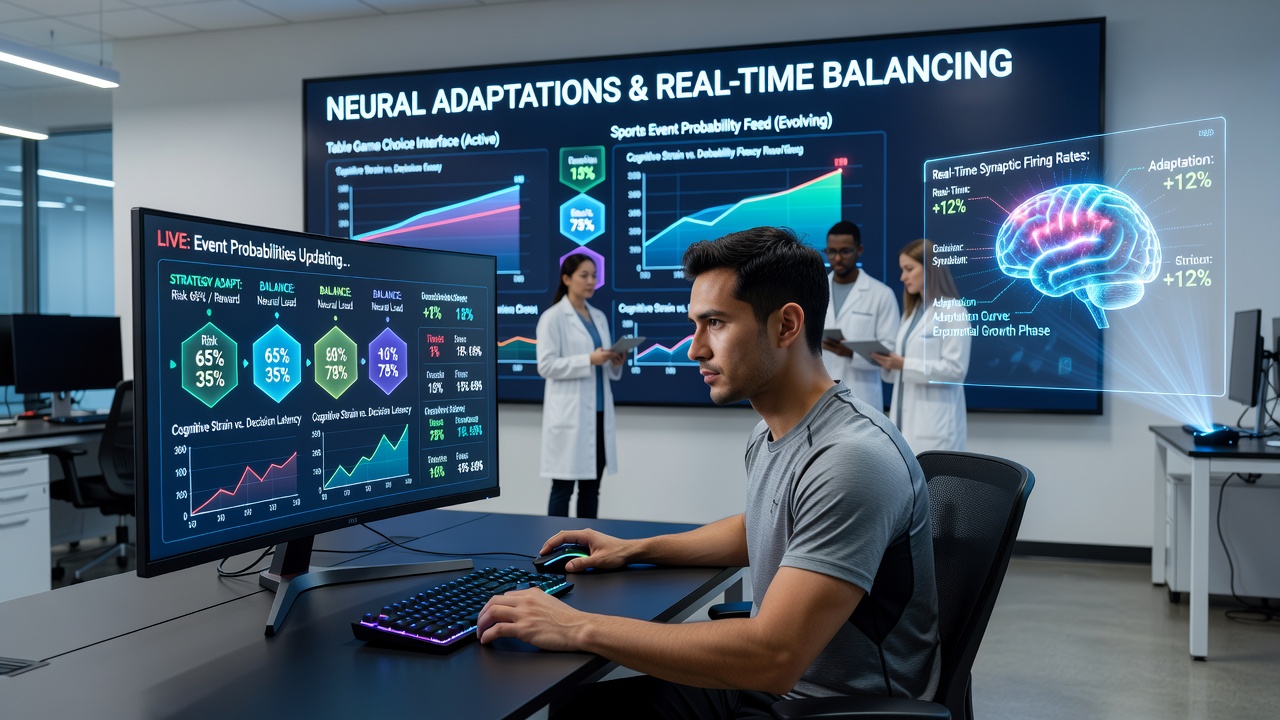
Researchers at institutions tracking gambling behavior across North America have documented that users who balance these demands exhibit stronger theta-band oscillations during decision points, a marker associated with active information processing. The pattern holds across different age groups, though younger adults show slightly accelerated adaptation timelines according to aggregated platform analytics.
Probability Processing Under Concurrent Task Loads
Real-time sports probabilities shift continuously based on player performance metrics and external variables, while table game odds remain governed by combinatorial mathematics. Investigations into dual-task performance find that experienced players allocate visual attention across split-screen displays with greater precision, reducing errors in both domains. Figures from industry monitoring services indicate that error rates in odds interpretation drop by measurable margins after users complete roughly twenty mixed sessions.
Canadian regulatory bodies such as the Gambling Research Exchange Ontario have compiled reports showing that cognitive flexibility training elements embedded in certain applications correlate with improved outcomes in probability estimation drills. Similar findings emerge from European academic collaborations examining mobile user cohorts, where participants practiced rapid switching between game modes.
Attention Networks and Decision Timing
Handheld interfaces present information in condensed formats that demand selective focus, prompting adaptations in the dorsal attention network. Players learn to filter irrelevant notifications while monitoring both game state and live event feeds. Data collected during August 2026 revealed that peak engagement periods aligned with major sporting events, during which users displayed elevated sustained attention metrics on backend telemetry.
Neuropsychological assessments of frequent users indicate preserved performance on standardized tests of executive function, suggesting that the adaptations remain task-specific rather than producing broad cognitive enhancements. One study tracking participants over three months found stable improvements confined to probability-related decision speed within the application environment.
Conclusion
Neural adaptations associated with balancing table game choices and evolving sports probabilities on handheld applications center on strengthened connectivity in attention and reward circuits, alongside refined probability processing efficiency. Available evidence from multiple research groups points to measurable changes that develop through repeated practice, with platform data from August 2026 supporting continued exploration of these patterns. Further studies from organizations such as the National Institute on Drug Abuse continue to examine the boundaries of these adaptations across varied user populations.